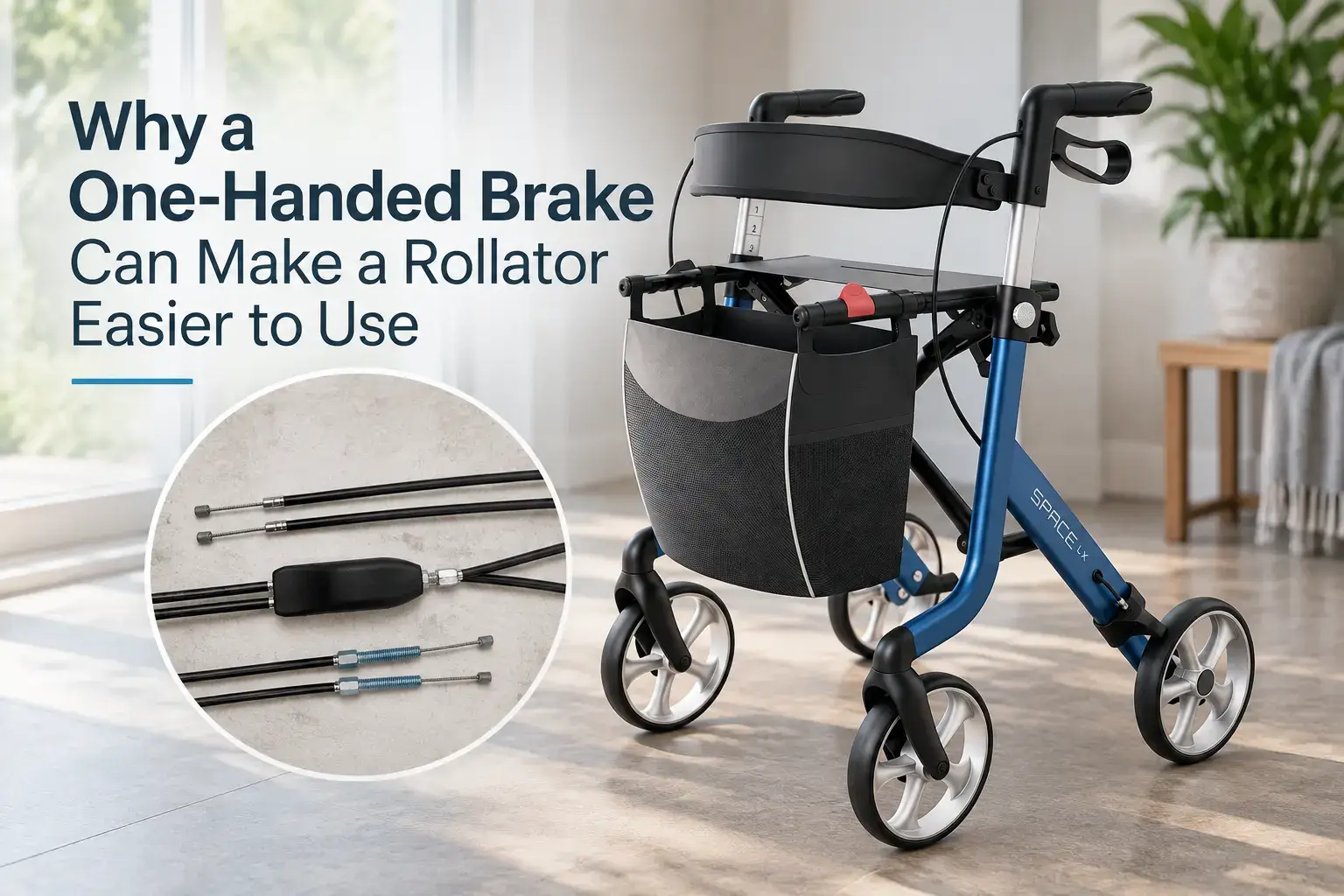
For most people, using the brakes on a rollator is something they don’t really think about. There is usually a brake lever on each handle, and squeezing the levers allows the user to slow down or stop the rollator.
But what if using both hands isn’t easy?
For someone with reduced strength, movement or coordination in one hand, operating two separate brake levers can be difficult. This can be particularly relevant for people who have experienced a stroke, or those living with conditions such as arthritis or rheumatism that affect their hands.
This is where a one-handed rollator brake can be a useful option.
A one-handed brake system allows both sides of the rollator to be controlled using a single brake lever. This means the user can operate the braking system from the side that is most comfortable for them.
Most conventional rollators have two brake levers – one on each handle. Each lever normally controls the braking on its respective side.
A one-handed braking system works differently. The two sides of the braking system are connected, allowing a single brake lever to activate the brakes on both sides of the rollator.
In simple terms, you can operate both brakes with one hand.
Depending on the rollator and the braking system available, the one-handed brake can be configured for use on either the left or right side.
For someone who has good use of one hand but limited function in the other, this can make the rollator considerably easier to control.
A one-handed brake can be useful for anyone who finds operating two brake levers difficult.
This may include people with:
It is important to remember that everyone’s abilities are different. Having a particular condition doesn’t automatically mean that a one-handed brake is required.
Instead, consider whether the person can comfortably and reliably operate the brakes on both sides of a conventional rollator.
If they cannot, a one-handed brake may be worth considering.
The brakes on a rollator aren’t simply there to bring it to a stop.
They can be used to help control the rollator when walking and are particularly important when the user needs to stop.
Rollators with seats also typically have parking brakes. These allow the rollator to be secured when the user wants to sit down and rest.
Being able to operate the brakes confidently is therefore an important part of using a rollator.
If someone struggles to use both brake levers, the problem isn’t necessarily the person’s ability to use a rollator – it could simply be that the braking system isn’t suited to their needs.
One of the main advantages of a one-handed brake is simplicity.
Instead of needing to grip and squeeze two separate brake levers, the user can operate the braking system from one side.
This can be particularly helpful if one hand has significantly better strength or control than the other.
For example, someone who has limited movement or grip on their left side may find it much easier to use a brake lever positioned on the right handle.
Rather than having to adapt their movement to a conventional two-brake setup, the rollator can be configured around the way they are able to use it.
When choosing a mobility aid, it’s easy to focus on the main specifications – the weight, width, wheel size, seat height and whether it folds.
Those things are important, but the smaller details can be just as significant.
A rollator needs to be something the user can operate confidently.
If a person can walk with a rollator but struggles to operate the brakes because one hand has limited function, that can create an unnecessary barrier to independent use.
A one-handed rollator brake can remove that particular difficulty by allowing the user to operate the braking system with the hand they have the best control over.
It’s a good example of why choosing the right accessories and configuration can be just as important as choosing the rollator itself.
At HWB Mobility, we offer the Rehasense Space LX Rollator, a lightweight rollator that can be configured with a range of accessories.
One of the available accessories for the Space LX is a one-handed brake system.
This provides an option for users who may find operating conventional brake levers on both sides difficult. The system can be set up for use from either the left or right side, depending on the user’s requirements.
The Space LX is worth considering if you’re looking for a rollator with a one-handed brake or a rollator that offers additional options to suit individual requirements.
If you’re buying a rollator for yourself, a family member or someone you care for, think about more than just whether it provides support when walking.
Consider how the person will actually use it.
If they have limited strength or movement in one hand, operating two brakes may be difficult.
A one-handed braking system may allow the rollator to be configured around the user’s stronger or more capable side.
If the rollator has a seat, being able to apply the parking brakes is particularly important before sitting down.
A rollator that can be adapted with different accessories may offer a more suitable solution as the user’s requirements change.
There’s no single rollator that’s right for everyone.
The best choice depends on the individual’s mobility, strength, hand function and how they intend to use the rollator.
If someone finds it difficult to operate the brakes on both sides of a conventional rollator, a one-handed brake system could make the rollator easier to control and more practical for everyday use.
It’s also worth remembering that the brake system is only one part of choosing the right rollator. Factors such as seat height, overall width, weight, handle height, wheel size and the user’s ability to manoeuvre the rollator should all be considered.
At HWB Mobility, we can help you understand the options available and find a rollator configuration that suits the individual user.
The Rehasense Space LX Rollator is available with a range of accessories, including a one-handed brake system, making it an option worth considering for people who have difficulty operating conventional two-sided brakes.
If you’re unsure whether a one-handed brake or another rollator accessory would be suitable, get in touch with HWB Mobility and we’ll be happy to discuss your requirements.
Find out more about the Rehasense Space LX Rollator, including its specifications and available accessories, on the HWB Mobility website.
A one-handed rollator brake allows the user to operate the braking system on both sides of the rollator using a single brake lever. This can be useful for people who have reduced strength, movement or coordination in one hand.
A one-handed brake may be useful for people who have difficulty operating two brake levers simultaneously. This can include some people with reduced hand function following a stroke, arthritis, rheumatic conditions or reduced grip strength on one side.
Depending on the rollator and braking system, a one-handed brake can be configured for either the left or right side. This allows the user to operate the brakes with the hand they have the best control over.
Some rollators can be configured to make one-handed operation easier, including models with a one-handed braking system. However, the user’s ability to safely control and manoeuvre the rollator with one hand should always be considered when choosing a mobility aid.
It depends on the make and model of the rollator. One-handed braking systems are not necessarily compatible with every rollator, so it is important to check which accessories are available for the specific model.
Yes. A one-handed brake system is available as an accessory for the Rehasense Space LX Rollator. The system can be configured to allow the brakes to be operated from either the left or right side, depending on the user’s requirements.
Yes. If you’re unsure which rollator or accessories would be suitable, HWB Mobility can discuss your requirements and help you understand the options available. The right choice will depend on the user’s mobility, hand function, strength and how they intend to use the rollator.
