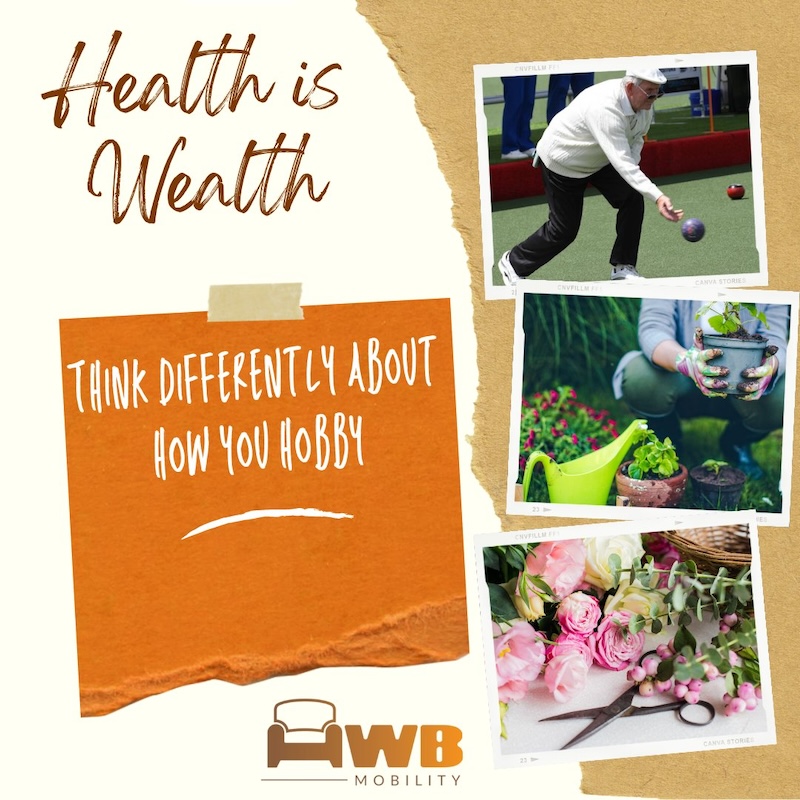
Health is wealth. We can’t put a price on it. Or at least, if we could, not one of us would be able to afford it. Not even the richest folk on the planet, not even Jeff Bezos!
Most of the things we do on a daily basis, we take for granted, we never think about a time when we might not be able to do them either.
We only really appreciate how good our quality of life is when we suddenly aren’t able to do something as easily as we once were. Which, in truth, is more of a yearning than an appreciation.
What hurts the most is when we’re no longer able to do something that we love but what if I told you, “you might still be able to do it, just in a different way?”
The benefits to our mental health from doing the things that we enjoy are huge.
Sadly, the opposite is also true. When we eventually decide enough is enough, or it just seems like a physical impossibility to carry on, it can have detrimental effects on our state of mind.
Take bowls as an example. Not your most extreme sport but one that requires a lot of bending and walking. It also demands tremendous hand-eye coordination and it makes us think tactically.
If we suddenly stop playing, we’re not just not getting that physical exercise anymore, we’re missing out on that mental stimulation too. The feel-good factor we get from social interaction is also something that will be missed dearly.
Thankfully, for every problem, there seems to be a solution these days.
If bending is what you have difficulty with, there’s a Bowls & Jack Lifter for that!
There’s also a “bowling arm” which allows you to remain upright while the arm acts as an extension to yours and gets closer to the floor than perhaps you can.
Some clubs even have a Bowls Royce for you to make use of if walking is what’s most problematic to you. The golf buggy of the bowling world if you will!
Just by breaking it down like this, it’s clear to see how one’s mental health could be negatively impacted by no longer taking part is something that we love to do.
It isn’t just one thing that we lose out on by no longer participating, but a culmination of lots of different aspects, potentially leading to feelings of isolation, depression and a decline in our physical health. Use it or lose it!
Regardless of our interests, adapting to our changing needs is key. We just need to look at things a little differently.
There’s no shortage of adaptive equipment to make doing what we enjoy easier and if we embrace them, we may be able to continue to do the things that we love for longer.
We’ve used bowls as an example but the same can be applied to lots of other hobbies too.
There’s so many adaptive tools that have been invented to make the world of gardening so much easier for instance.
Specialist seats to save you kneeling, extendable tools to limit bending, larger implements for easier grip, you’ve only got to search adaptive gardening tools to realise just how vast the range is.
You may not be able to spend hours at a time, knee deep in compost these days but that certainly doesn’t mean that you can’t still get your hands dirty.
When we reach our twilight years, there’s a perception that people stop having fun.
Care Homes are viewed as places that people go when they can’t look after themselves anymore and have pretty much given up on life.
This couldn’t be further from the truth. Yes people may need assistance with certain aspects of their lives but they lead extremely fulfilled and action packed ones whilst living in Care Homes that make even the most zealous party animals envious.
They have lots of people to talk to and there’s something different to try their hands at almost everyday.
Baking to Bowling, Pizza Making to Mocktail Tasting, there’s so much going on in Care Homes that you wonder where the misconceptions came from in the first place…It’s basically like being on a Cruise for the rest of your life, only more fun.
Care Home Activity Coordinators and those that support them are worth their weight in gold!
They are constantly thinking of new ways to make life more fun for the people that live in the homes they work in.
Caroline J Benham, creator of Bright Copper Kettles is someone we have connected with on LinkedIn and her passion for improving the opportunities for activity in later years and, in particular, for those with dementia is inspirational.
Caroline posted recently about flower arranging as an activity. Only, she didn’t stop there. She talked about the many tasks that could accompany this activity, potentially resulting in those completely uninterested in matching their Geraniums with their Gypsophila, getting involved.
These were some of the suggestions:-
It was this post that inspired us to write this blog post. We wanted to encourage people to not give up on their passions. We want people to continue to do the things they love for as long as they can and with a teaspoon of thought, a tablespoon of internet searches and a bucket load of determination, it’s plain to see you can.
Our challenge to you is not to give up doing what you love. We’d would love to hear about your hobbies that you’re determined to keep doing and ways you’ve overcome any obstacles. We might even edit the post to include some of your ingenuity.
