
Electric mobility scooters are incredible devices that change people’s lives for the better. They are the difference between a person being housebound and reliant on other people vs still being able to enjoy the great outdoors and hold on to that all important independence for as long as possible.
If I were asked to give just one piece of advice when it came to purchasing an electric mobility scooter, it would be not to rush into anything.
What will you use it for? What type of surface will you be driving on? How far will you be travelling? Where will you keep it? What are the local laws? What if it breaks down?
These are all questions you need the answers to before deciding on what type of mobility scooter will be the best fit for you.
We’ve visited so many people that have made mistakes when purchasing a mobility scooter. This blog post aims to give people as much information as possible in order to make an informed choice about their next electric mobility scooter.
In law, there are 2 classes of mobility scooter; Class 2 mobility scooters and Class 3 mobility scooters. Here are the main differences between the two.
Class 2 scooters are permitted on footpaths and pavements but not roads. In places where there isn’t a footpath or pavement, they are allowed on the road. They are restricted to 4mph and here’s some of their key features:-
Class 3 scooters can go on roads and pavements. They have a top speed of 8mph but mustn’t exceed 4mph on pavements. A setting on your class 3 scooter will restrict it to 4mph. Class 3 mobility scooters are generally bigger, heavier versions of their Class 2 counterparts.
This is a topic worthy of discussion too. Firstly, there are manual folding scooters like the Motion mLite which weighs just 17.9KG when you slip the battery out and there are automatically folding scooters like the eDrive which folds flat in 7.5 secs!
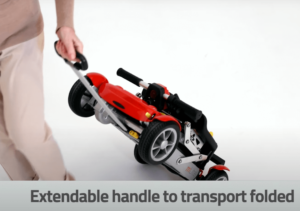
Clearly, folding something vs dismantling it, means it’s going to be heavier than if you were to take it apart, as it’s still all in one piece.
The benefits of folding electric mobility scooters are that they are quicker and more convenient than their dismantling counterparts. Making sure you have the strength to then easily lift it in and out of your car boot will be key. The Motion mLite though, does have an extendable handle which allows you to carry it along on its wheels when folded, much like a suitcase.
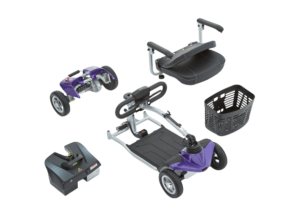
Dismantling a mobility scooter, although more of a “faff” than folding one, does mean the heaviest part is significantly lighter, making it that much easier to get in and out of the boot of your car.
The Evolite doesn’t take any time at all to dismantle though and if you have a *really* small boot, you also have the option of putting some of the parts on the back seat. The heaviest part of this boot scooter is just 10KG!
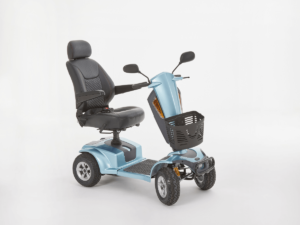
It’s funny you should ask that, and as a matter of fact, yes, yes we do! At the time of writing, we currently have just the 1 Class 3 Electric Mobility Scooter on our site and that is the Xcite. What a beauty it is too! There are 2 versions of the Xcite, the Xcite and the Xcite Li. The difference being the distance you are able to travel on a single charge. The Xcite will give you a very commendable, industry standard 25 mile range but the Xcite Li will travel up to 45 miles on a single charge! This is as far as anything on the market today!
The answer to this will depend largely on what type of mobility scooter you decide upon. Compact, folding dismantling scooters tend to be left in boots of cars until they are needed. Larger road scooters require more consideration. If you’re planning on keeping it indoors, check to see if you’re going to need a ramp to get over the threshold of your doorway. If you’ve got a garage with enough space to accommodate your class 3 mobility scooter, that could be a good option too.
Whilst researching this blog post, we came across ibox, a family owned and run business, based in Bradford, specialising in electric mobility scooter storage boxes! We reached out to them and Paul came back to us, saying he was delighted that we wanted to feature them in our blog post!
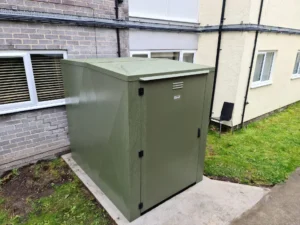
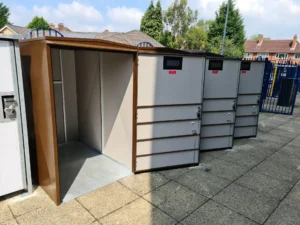
Their boxes come in various sizes and colours or they can even make them to your specifications.

To get in touch with them directly, please call 01274 573110 or email them at enquiries@ibox.works.
The short answer is no. But. There’s always a but. It is recommended. You only have to Google, “mobility scooter insurance” to see an array of various providers of such things. Our advice would be to do your research and find one that is suitable for your needs. You have to consider worst case scenario and that is if you are out and about and your scooter suddenly stops working, what are you going to do? Insurance/breakdown cover suddenly seems like a good idea doesn’t it?
You do not need a licence to drive a mobility scooter but you’ll need to register class 3’s.
Class 3 electric mobility scooters need to meet the following criteria:-
For more information, visit the government’s website.
If this blog post has stopped just one person from ordering the first scooter they click on, it will have been worth writing! We wrote it to encourage you to research the market, to measure up and to think about all the possible scenarios. Whether you get a scooter from us or elsewhere, it doesn’t matter, just take your time and please get in touch for any more advice.
Shop around, go for test drives (if you’re in South Wales, we can come to you with any of our scooters and give you a demonstration) do your research and do everything you can to get it right first time.
If you have any questions whatsoever, please get in touch. 0800 933 0389 | chat@hwbmobility.co.uk
